
Why the Egyptians Left the Great Pyramid Blank
The chambers inside the Great Pyramid of Giza are infamously devoid of inscriptions. But what if the pyramid was never meant to be silent?
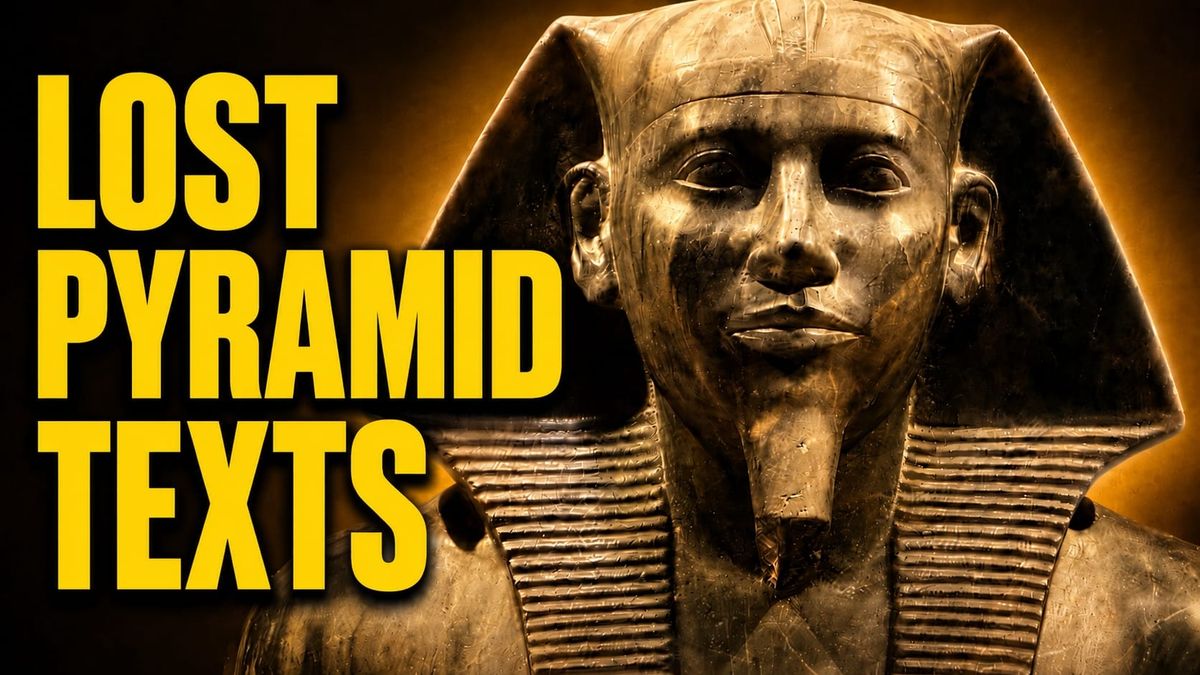
Step inside the Great Pyramid of Giza, and you find yourself face to face with one of the strangest facts of ancient history.
The walls of the pyramid have nothing to say.
No spells or prayers. Not even the name of the king.
The Giza pyramids are infamously devoid of inscriptions. But what if the pyramids were not meant to be silent? What if the texts they contained are simply lost?
Based on recent investigations, that's exactly what I believe happened.
And by the end of this episode, you just might too.
The silence of the 4th Dynasty pyramids of Khufu, Khafre and Menkaure has fueled countless theories about Giza—about what these monuments really are, and what was supposed to happen inside of them.
What makes the silence truly strange is this: Other Egyptian pyramids have walls filled with writing. The inner chambers of later pyramids, starting with a 5th Dynasty king named Unas, are covered floor to ceiling in hieroglyphs.
These spells are the oldest surviving religious writings in history. They aimed to transform the king into a god and enable his ascent to the sky. Today we call them the Pyramid Texts.
But they've left us with a real puzzle. Why are the grandest pyramids ever built completely bare, while the more modest, later pyramids are replete with writings?
The standard theory is that the texts just had not been written until after the Giza pyramids and must have been composed around the time that they were first inscribed during the 5th Dynasty.
But several top Old Kingdom scholars have come to a different conclusion. Recent studies suggest the story of the pyramid texts begins much earlier. [Baines; Mathieu, "Les formules..."]
The texts contain many signs of being copies of older documents. This includes evidence of corrections, which shows that the texts were not originally written for the king Unas and must have been composed at an earlier point. [Mathieu, "Modifications..."]
The Pyramid Texts also combine mythological traditions that seem to have developed separately.
A key example concerns Horus, who in later traditions is almost always the son of Osiris. But in the Pyramid Texts, he sometimes has a different genealogy, appearing instead as the son of the earth god Geb. [PT 478]
Archaic language in many of the writings adds even further weight to the idea that the Pyramid Texts had developed over a long period of time. In other words, far from being a new invention, the Pyramid Texts look a lot more like a compilation of a much older set of traditions.
But how old exactly?
Recently, two scholars have suggested that core elements of the Pyramid Text spells could have emerged centuries earlier than usually thought. [Baines; Mathieu, "Les formules..."]
These assessments suggest that the origins of the Pyramid Texts could go all the way back to the 2nd Dynasty or even further. That makes it entirely plausible that some version of the afterlife spells existed at the time of the pyramids of Giza.
Which brings us back to the bare walls of the Giza pyramids. If the Pyramid Text spells or something like them already existed in the age of Khufu, why aren't they carved inside the Great Pyramid?
The Pyramid Texts themselves seem to offer an answer. Spell after spell opens with the same phrase: "Words to be spoken."
Clearly an oral tradition was at the root of the Pyramid Texts. The spells originally could have been intended to be spoken inside the burial chambers at Giza.
At the same time, scholars believe it's likely that the Egyptians began writing down these spells on papyrus or leather pretty early on. Evidence of early religious writings as far back as the 2nd Dynasty makes this a real possibility.
And that's the key to this theory. Because according to one Egyptologist, Pyramid Text spells could have been present in written form within the Giza pyramids—just not inscribed on the walls. [Baines]
This theory suggests that the 4th Dynasty kings were already taking these texts into the tomb with them, written on their wooden coffins or linen wrappings, or on rolls placed in the burial.
The inscription of funerary texts on coffins is a well-known phenomena from ancient Egypt. It's just that this is usually seen as a later development.
But what if texts on coffins actually came first, prior to the texts in pyramids? That would explain why the Giza pyramid builders such as Khufu did not feel compelled to inscribe their chambers.
They had everything they needed within the burial itself.
Of course, if the Giza burials once contained sacred writings, an obvious question follows: Where are they?
Because no Old Kingdom royal burial has ever been found intact, any evidence is long gone. The objects containing funerary spells are the ones that were most likely to have been taken by tomb robbers.
The granite sarcophagi of the Old Kingdom pyramids are all that's left, and they are empty.
That raises another big question. If kings had been taking these texts into the burials for centuries, why did King Unas and his successors start carving them into stone?
While it's impossible to know for sure, one can envision multiple motives at work.
Given the likelihood of tomb robbery, the Pyramid Texts may have been created as a backup system to the texts that were written on portable objects in the burial. The inscriptions would have given permanence to the spells through embedding them right into the walls.
A thief could carry off a papyrus roll or tear apart a coffin, but the walls were staying put.
The carving of the pyramid texts might have had another motive for Unas as well. The expanded textual surface would have been seen to endow the king with greater magical power for his afterlife journey. [Billing]
We can see this impulse clearly in the successors of Unas in the 6th Dynasty when the pharaohs kept expanding the corpus. The chambers of King Pepi I contained more than three times as many lines of text as the pyramid of Unas.
Each king wanted more spells than the last. And if this theory is right, Unas himself was doing the very same thing, expanding on the more modest set of texts that the 4th Dynasty kings had taken into their burials.
It would also mean that the emptiness of the pyramid chambers is not what it seems.
Based on evidence that is little-discussed outside of Egyptology, it's clear that earlier prototypes of the pyramid texts could very well have existed by the time of the Giza pyramids. One of the biggest clues comes from the pyramid that started it all, the step pyramid of the 3rd Dynasty king, Djoser.
Built upward in a series of ascending levels of stone in the desert necropolis of Saqqara, the step pyramid was the product of Djoser's famous architect, Imhotep. As the excavator of the pyramid once put it, the monument was clearly envisioned by Imhotep as a "gigantic flight of steps rising to the sky, as if to facilitate the ascent of the dead king's soul." [Lauer]
In the Pyramid of Unas, which he built just a few minutes walk from the Djoser complex, one of the inscribed spells discusses the afterlife journey of the king in a strikingly similar way: "A stairway to the sky is set up for me that I may ascend on it." [PT 267]
In other words, the architecture of the earliest pyramid, built well before the Giza pyramids, and the theology of the later Pyramid Texts are cut from the same cloth.
But that isn't the only connection between the 3rd Dynasty and the Pyramid Texts. A 3rd Dynasty shrine built by Djoser features members of the divine family of the Pyramid Texts known as the Ennead.
It was discovered at the site of ancient Heliopolis in modern Cairo, which is where most Egyptologists believe the original Pyramid Text theology was developed.
According to one scholar, it's not far-fetched to think that Imhotep himself—who held a title later linked to Heliopolis and who was remembered as a great writer—may have had a hand in the development of this theology. [Barta]
And yet nearly everything from ancient Heliopolis, save for one lone obelisk, was dismantled and carted off as building materials.
My point is, this is yet another reason why we shouldn't expect much of a paper trail for the composition of the Pyramid Texts.
But in terms of the evidence that has survived, it points in a remarkably consistent direction, and that direction is up. Across the royal pyramids, we find design elements that seem to resonate with the cosmic themes of the pyramid texts.
The Great Pyramid of Khufu, for instance, has descending and ascending passages, a celestial orientation and shafts aimed toward the sky. [Nell and Ruggles; Spence]
The architecture does seem to be speaking the common language of cosmic alignment and upward movement shared by both the earlier pyramids, such as Djoser's, and later pyramids, such as that of Unas.
Even the sarcophagus itself has been interpreted in light of the Pyramid Texts as a symbol of the sky goddess Nut from whom the deceased king was reborn. [Edwards]
In other words, the walls of the Great Pyramid may be bare, but the building itself seems to be tuned to the same frequency as the later texts carved in stone.
When it comes to the corpus of spells we know today as the Pyramid Texts, it's clear that some version of them, now lost, could have served Khufu just as they would later serve Unas.
Unas, from our vantage point, is simply the moment the tradition becomes visible.
For centuries before that, the words may have been spoken in darkness, recited from papyri, painted on coffins.
Eventually, the Egyptians took this ritual technology and carved it into the pyramid itself. And because they did, we're finally able to hear the voice that was probably present in some form all along, the voice of the pyramid.
A voice saying, the king is not dead.
The king lives.
The king becomes an eternal being of light and ascends to the gods.
The Pyramid Texts are not just the earliest religious writings in history. They are a portal into a long-forgotten world of sacred traditions about death and the afterlife.
These texts may also be the explanation we've been seeking for one of the biggest mysteries of Giza—the mystery of why inside the greatest pyramid of all, the walls never needed to say a word.
Bibliography
- James Allen. The Ancient Egyptian Pyramid Texts, Second Edition (2015)
- James Allen. "Reading a Pyramid" in Hommages à Jean Leclant 1 (1994)
- Dorothea Arnold, Christiane Ziegler, Catherine Roehrig. Egyptian Art in the Age of the Pyramids. (1999) Djoser reliefs: Pp. 175-176
- John Baines. "Modelling sources, processes, and locations of early mortuary texts" in D'un monde à l'autre: Textes des Pyramides & Textes des Sarcophages (2004) Pp. 15-41
- Winfried Barta. Untersuchungen zum Götterkreis der Neunheit (1973)
- Susanne Bickel. La cosmogonie égyptienne: avant le Nouvel Empire (1994)
- Nils Billing. The Performative Structure: Ritualizing the Pyramid of Pepy I (2018)
- I. E. S. Edwards. "Do the Pyramid Texts suggest an explanation for the abandonment of the subterranean chamber of the Great Pyramid?" in Hommages à Jean Leclant 1 (1994) Pp. 159-167
- Raymond Faulkner. The Ancient Egyptian Pyramid Texts (1969)
- Jean-Philippe Lauer. Les Pyramides De Sakkara / The Pyramids of Sakkara. Revised edition (1991)
- Antonio Loprieno. "Temps des dieux et temps des hommes en ancienne Egypte" in Représentations du temps dans les religions (2003) - espec. pp. 126-127.
- Bernard Mathieu. "Modifications de texte dans la pyramide d’Ounas" BIFAO 96 (1996) Pp. 289-311
- Bernard Mathieu. "Les formules conjuratoires dans les pyramides à textes: quelques réflexions" in La magie en Egypte. A la recherche d'une définition (2002) Pp. 185-206
- Bernard Mathieu. "La distinction entre Textes des Pyramides et Textes des Sarcophages est-elle légitime?" in D'un monde à l'autre: Textes des Pyramides & Textes des Sarcophages (2004)
- Erin Nell and Clive Ruggles, “The Orientations of the Giza Pyramids and Associated Structures,” Journal for the History of Astronomy 45, no. 3 (2014) Pp. 304–360
- Kate Spence, “Ancient Egyptian Chronology and the Astronomical Orientation of Pyramids,” Nature 408 (2000) Pp. 320–324
Images/footage
All photos and videos are by the author, with the exception of:
- Funerary texts on coffins: Coffin of Ukhhotep, son of Hedjpu, The Metropolitan Museum of Art (public domain)
- Papyrus sheet: Heqanakht Letter I, The Metropolitan Museum of Art (public domain)
- Image of Geb: Book of the Dead of Nestanebetisheru, frame 87, The Trustees of the British Museum
References
Pyramid inscription begins with Unas
Other Egyptian pyramids have walls filled with writing. The inner chambers of later pyramids, starting with a 5th Dynasty king named Unas, are covered floor to ceiling in hieroglyphs.
For the translated corpus:
- Raymond O. Faulkner, The Ancient Egyptian Pyramid Texts. Oxford: Clarendon Press, 1969.
- James P. Allen, The Ancient Egyptian Pyramid Texts, 2nd ed. Writings from the Ancient World 38. Atlanta: SBL Press, 2015.
The earliest connected set of Pyramid Texts are those of Unas at the end of the 5th Dynasty, but fragments of the tradition appear a bit earlier. Baines points to the 5th Dynasty mortuary temple of Sahure as the first attestation of related material (Baines 2004, pp. 15–16).
The Pyramid Texts may be older than usually believed
...several top Old Kingdom scholars have come to a different conclusion. Recent studies suggest the story of the pyramid texts begins much earlier.
This is Baines, "Modelling sources...", and Mathieu, "Les formules..." More on this below.
The texts contain many signs of being copies of older documents. This includes evidence of corrections...
Mathieu's study of the physical carving in the pyramid of Unas demonstrates convincingly that the earliest inscribed corpus is clearly not a fresh invention: Bernard Mathieu, "Modifications de texte dans la pyramide d'Ounas," BIFAO 96 (1996), pp. 289–311.
Mathieu states that the Unas texts, carved ca. 2380–2350 BCE, already represent a culmination, and that the composition of most of the inscribed spells probably preceded the reign of Unas by several centuries (p. 289). His evidence includes the 163 recarvings/corrections still visible on the walls.
The decisive evidence is the pair of recarvings on the north wall of the passage between the burial chamber and antechamber, where the cartouche of Unas was carved over an earlier nsw, "king" (pp. 290–291, figs. 2–3). As Mathieu puts it, this is proof that an anonymous text, which had not been specifically designed for Unas, existed before his reign (a point he restates in the 2002 study, p. 188). He counts 163 corrections in all, several of which are explained by a scribe misreading a hieratic master copy while transcribing it into monumental hieroglyphs—i.e. the wall texts were copied from a manuscript (pp. 290, 296–297; more on this below). Faulkner had assumed the original spells were spoken by the king in the first person; Mathieu shows the underlying voice is often a ritualist speaking about the king in the third person, which the Unas editors then converted (pp. 291–292).
But in the Pyramid Texts, [Horus] sometimes has a different genealogy, appearing instead as the son of the earth god Geb.
Horus is cited as the son of Geb twice in PT 478 (Allen 2015, p. 275). PT 615 also has Horus as brother of Seth (Allen 2015, p. 232), while the phrase "Nut's Horus" can also be found in PT 681 (Allen 2015, p. 283).
Archaic language in many of the writings...
Allen 2015, p. 4: "Although they are first attested in the pyramid of Unis, most of the Pyramid Texts are undoubtedly older. With few exceptions, their grammar is that of a stage of the language older than that which began to appear in secular inscriptions at least fifty years earlier ... Overall, the Pyramid Texts give the impression of a corpus that had been in use for some time before it was inscribed in Unis’s pyramid."
Arguments for a much earlier origin
Recently, two scholars have suggested that core elements of the Pyramid Text spells could have emerged centuries earlier than usually thought.
This again is Baines and Mathieu, "Les formules..."
Baines models the transmission as a "double transition from oral to written and from written outside the tomb to carved within it" (p. 40). On antiquity specifically, he notes that "more than two hundred years of decorated and inscribed nonroyal sarcophagi preceded the inscription of similar materials on the walls of the king's burial chamber," and that this timespan is "slightly shorter than that of the writing of continuous texts since the late 2nd Dynasty; written mortuary texts could go back almost as far as that" (p. 41). Late 2nd Dynasty is ca. 2700 BCE; Unas is ca. 2350 BCE—so Baines is indeed pointing toward roughly a 2nd or early 3rd Dynasty horizon, several centuries before the inscribed corpus.
At the same time, Baines notes that "there is no absolute reason why some texts should not have been composed as late as the time of Wenis" (p. 16). His model pushes the tradition back, without claiming every formula is archaic.
Mathieu argues that, since no pyramid is ever mentioned in the Pyramid Texts, it would be justified to trace the essential composition of the corpus back to a period earlier than the construction of the pyramids, namely the very first dynasties of Egyptian history, including Dynasty 0 around 3300–3150 BC and the two dynasties of the Thinite period, around 3150–2700 BC (pp. 188–189).
Mathieu deliberately says the essential composition. In the same passage he notes that it would be excessive to assign the date of composition of all the formulae to one single moment, and he distinguishes three categories of formulae (offering, "cosmographic," and conjuratory) that need not be equally old. The ~3300 BC figure is his high-water mark for the oldest stratum, not a claim that the whole corpus is Predynastic.
An oral tradition, written down early
Spell after spell opens with the same phrase... At the same time, scholars believe it's likely that the Egyptians began writing down these spells on papyrus or leather pretty early on.
See Baines, "Modelling sources, processes, and locations of early mortuary texts" (2004), pp. 15–41. His whole essay is built on the oral → written-on-portable-media → carved-on-walls trajectory. On the written archive specifically, Mathieu 2004 assembles the hard evidence in "La distinction entre Textes des Pyramides et Textes des Sarcophages…" (2004), pp. 251–253.
- Construction marks reading mdȝt nṯr, "the roll of the god" (i.e. the papyrus roll), painted on the blocks behind the inscribed walls of Queen Ankhesenpepy II's burial chamber (p. 253) — a literal reference to the manuscript source.
- Sign-confusions in Unas that only make sense as misreadings of a hieratic model transcribed "from roll to wall" (p. 252; detailed in Mathieu 1996, pp. 296–297).
- The column layout and right-to-left orientation of the hieroglyphs, which "seems to reproduce that of a manuscript model" (p. 252).
Evidence of early religious writings as far back as the 2nd Dynasty makes this a real possibility.
Sealing of Peribsen, cited by Baines, p. 17. For more on the sealing, see Loprieno, pp. 126-127.
according to one Egyptologist, Pyramid Text spells could have been present in written form within the Giza pyramids, just not inscribed on the walls.
This is Baines (2004), pp. 40–41. He argues that the inscribed Pyramid Texts are "secondary" and "largely nonutilitarian" — "tokens of a larger whole that was performed or perhaps included in another medium in the burial" (p. 16, p. 40). The absence of texts on the walls at Giza therefore says nothing about whether the spells existed.
Coffins before pyramids
This theory suggests that the 4th Dynasty kings were already taking these texts into the tomb with them, written on their wooden coffins or linen wrappings, or on rolls placed in the burial ... But what if texts on coffins actually came first, prior to the texts in pyramids?
See Baines (2004), pp. 40–41: "I suggest that kings before the late 5th Dynasty had 'coffin texts', or texts on other media — such as papyrus, leather, or linen — deposited around the mummy, and that the Pyramid Texts began as an outward migration of the existing coffin or burial texts onto the walls of the burial apartments." He restates it in the conclusion: "The hypothesis that royal coffin texts preceded the Pyramid Texts forms part of a model of practice" (p. 41).
The Middle Kingdom is the one major period with no attested royal mortuary texts, yet the tradition demonstrably continued (down to Nectanebo II); since Middle Kingdom pyramid burial chambers are undecorated, any royal texts of that period must have been on the coffin or on perishable media around the mummy — exactly the "invisible" mode he proposes for the Old Kingdom (p. 40).
That would explain why the Giza pyramid builders such as Khufu did not feel compelled to inscribe their chambers. They had everything they needed within the burial itself.
Consistent with Baines's "tokens of a larger whole" argument (pp. 16, 40).
Empty sarcophagi and tomb robbery
Because no Old Kingdom royal burial has ever been found intact, any evidence is long gone. The objects containing funerary spells are the ones that were most likely to have been taken by tomb robbers. The granite sarcophagi of the Old Kingdom pyramids are all that's left, and they are empty.
Baines makes the methodological version of the point — that "the vast proportion of material… is lost," which "throws the exceptional character of what survives valuably into relief" (p. 41).
the Pyramid Texts may have been created as a backup system…
The author's proposal, building off the work of the other scholars cited here.
More text, more power? Pepi I vs. Unas
The expanded textual surface would have been seen to endow the king with greater magical power for his afterlife journey.
See Billing, espec. pp. 22-33.
The chambers of King Pepi I contained more than three times as many lines of text as the pyramid of Unas.
Allen 2015, p. 101.
The stairway to the sky
As the excavator of the pyramid once put it, the monument was clearly envisioned by Imhotep as a "gigantic flight of steps rising to the sky, as if to facilitate the ascent of the dead king's soul."
This is Jean-Philippe Lauer, Les pyramides de Sakkara / The Pyramids of Sakkara, revised ed. Bibliothèque générale. Cairo: IFAO, 1991, p. 12.
"'A stairway to the sky is set up for me that I may ascend on it."
Faulkner, The Ancient Egyptian Pyramid Texts (1969), Utterance 267, p. 76.
Djoser, Heliopolis and the Ennead
A 3rd Dynasty shrine built by Djoser features members of the divine family of the Pyramid Texts known as the Ennead. It was discovered at the site of ancient Heliopolis in modern Cairo...
See Dorothea Arnold, Christiane Ziegler, Catherine H. Roehrig (eds.), Egyptian Art in the Age of the Pyramids. New York: Metropolitan Museum of Art, 1999, pp. 175–176 (Djoser reliefs).
According to one scholar, it's not far-fetched to think that Imhotep himself—who held a title later linked to Heliopolis and who was remembered as a great writer—may have had a hand in the development of this theology.
This is from Barta 1973, p. 186. Barta notes that Imhotep, Djoser's architect and highest official, was also the first high priest of Heliopolis known from inscriptions, and so may have erected the cult shrine in honor of the Ennead. Imhotep could plausibly represent the outstanding personality responsible for the conception of the great Ennead, Barta writes.
ancient Heliopolis ... is where most Egyptologists believe the original Pyramid Text theology was developed.
See Bickel 1994 (espec. pp. 285–302).
Pyramid design as cosmography
Across the royal pyramids, we find design elements that seem to resonate with the cosmic themes of the pyramid texts.
The interpretive framework here—reading the substructure as a cosmic geography (burial chamber = Duat, antechamber = Akhet, serdab = Qebehu/"Freshness") — comes from Allen, "Reading a Pyramid," in Hommages à Jean Leclant I, Bibliothèque d'étude 106/1 (Cairo: IFAO, 1994), pp. 5–28.
Allen's 2015 introduction restates this cosmographic reading (e.g. the serdab as the eastern limit of the Akhet, "the point at which the Sun, and the deceased's spirit, left the womb of the Duat," with the blocked passage analogizing an irreversible birth — 2015, Introduction, pp. 12–13).
The Great Pyramid of Khufu, for instance, has descending and ascending passages, a celestial orientation and shafts aimed toward the sky.
See Nell and Ruggles, especially the discussion of Khufu’s pyramid and the authors’ conclusions regarding cardinal and stellar orientation, as well as Spence.
Even the sarcophagus itself has been interpreted in light of the Pyramid Texts—as a symbol of the sky goddess Nut, from whom the deceased king was reborn.
See I. E. S. Edwards, "Do the Pyramid Texts Suggest an Explanation for the Abandonment of the Subterranean Chamber of the Great Pyramid?" in Hommages à Jean Leclant I, Bibliothèque d'étude 106/1 (Cairo: IFAO, 1994), pp. 159–167.
Edwards argues that Pyramid Text theology explains a concrete architectural fact at Giza. His case (pp. 162–163): under the solar creed the dead king enters Nut at sunset, passes through her body, and is reborn at dawn (PT § 1688; § 780); the sarcophagus itself becomes a substitute for Nut's body — § 616, "you having been given to your mother Nut in her name of 'Sarcophagus.'" Once that theology took hold, a stone sarcophagus became indispensable — but it physically would not fit down the horizontal section of the Great Pyramid's Descending Corridor. Thus, Edwards argues, the burial chamber had to be relocated into the superstructure, and Khufu's hastily, poorly finished sarcophagus reflects the mid-project scramble.
Comments ()