
The Truth About Egypt and Greek Philosophy
There are two stories people tend to tell about the origins of ancient philosophy. And they're both wrong.
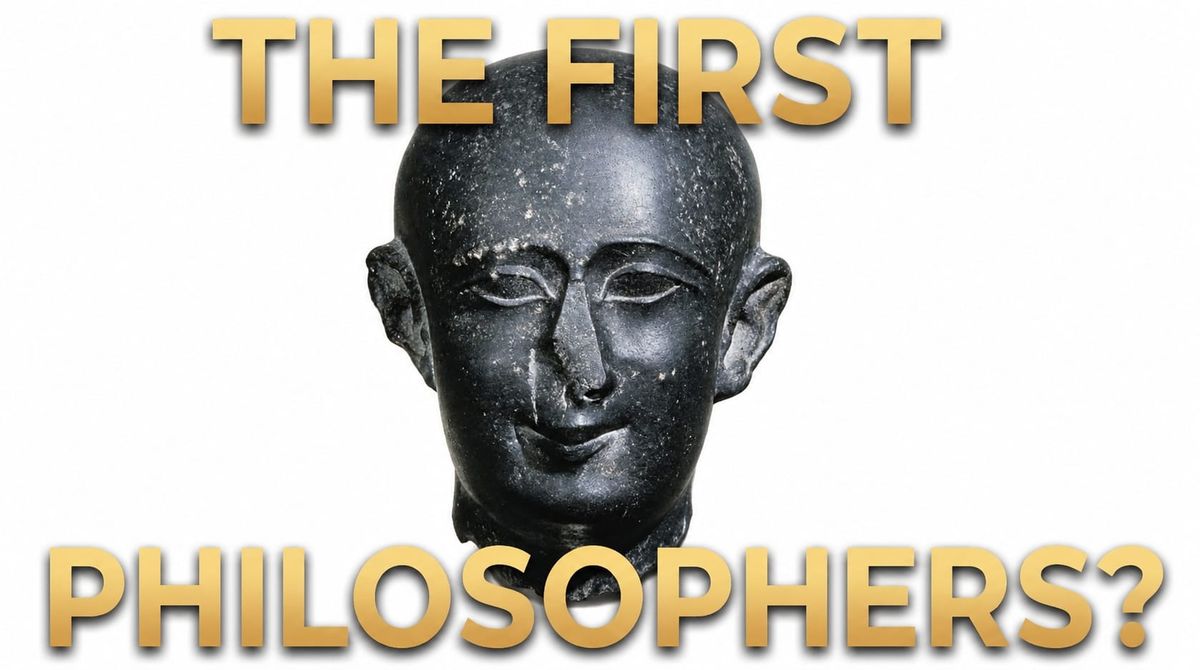
There are two stories people tend to tell about the origins of ancient philosophy. And they're both wrong.
The one you mostly hear is that Western philosophy began in ancient Greece, during the period known as the Greek Miracle. Before that, cultures such as Egypt were in a philosophical dark age, according to this view.
The second story swings in the other direction: The Greeks invented little to nothing of their own, including philosophy. Instead, they took all of their best ideas from older places such as Egypt.
Neither of these camps is correct. But I think the reasons why will surprise you.
Open a modern history of philosophy and here's what you'll read about ancient Egypt: It was a place where "no philosophy ever arose." None. A popular lecture course reaches the same dismal verdict: Egypt produced "not even a semblance of philosophical thought and practice."
At least they acknowledge Egypt, though. Plenty of other histories of philosophy skip right to the Greeks, with no mention of earlier civilizations whatsoever. Egypt who?
The claim that no philosophy arose in ancient Egypt is pretty easy to debunk, actually. You just need one Egyptian document, called the Memphite Theology.
This text-about the creation of the world through the thought and speech of the creator-is exactly the kind of theoretical work that was later associated with Greek philosophy, especially works such as Plato's Timaeus.
But you might ask, what about the famous philosophical arguments of Plato's student, Aristotle?
It turns out that Egypt had some of those too, according to the 2023 findings of one Egyptologist. (Mathieu 2023)
To understand this, we have to consider a well-known form of deductive reasoning, associated with Aristotle, which goes something like this: "All men are mortal; Socrates is a man; therefore Socrates is mortal."
This deductive concept is called a syllogism. And Egypt's oldest set of continuous writings, known as the Pyramid Texts, contains at least a dozen examples of this concept-2,000 years before Aristotle
Here's one example, pulled from the walls of an Old Kingdom pyramid: "Whoever performs this magic will live forever. I have performed this magic. Therefore I will live forever."
As you can see, this is a textbook syllogism. And in case you think the Egyptians might have just stumbled on this concept by accident, well, they didn't. We know that, because the syllogisms are specially labeled to show that the author was consciously deploying this type of reasoning. The ancient authors of the Pyramid Texts knew exactly what they were doing. They were doing what we today would call Aristotelian logic.
OK, so when it comes to ancient philosophy, Egypt is back on the table. So where does that leave the Greek Miracle?
It is true that Greece may owe a bigger intellectual debt to Egypt than is often acknowledged. Plato and other famous Greeks probably did visit the country, something I plan to cover in a future episode.
But it's not a matter of stealing ideas. They were just doing what nearly all great thinkers do-absorbing the ideas that were important in their time and making them their own.
The arguments by some authors claiming Greece's wholesale dependency on Egypt are baseless.
They aren't any more justified than the idea that Egypt had no philosophy at all. Both of these extreme positions make the same mistake, assuming that philosophy could only have been discovered once.
But why? Humans everywhere carry the same cognitive equipment.
What's far more likely is that philosophy of this sort is something that many ancient cultures reached independently. So to the question of who were the first philosophers, the Egyptians or the Greeks-in all probability, neither.
There's still one more issue with the Greek Miracle story, and it's something that almost nobody notices.
Now, in all fairness, the scholars who claim the Egyptians entirely lacked philosophy are not stupid. But they go astray by imposing a narrow definition on philosophy, one that says real philosophy has to be secular and devoid of "contamination" from religion.
Here's the problem. If philosophy must be secular, by that measurement, most of the ancient Greeks don't qualify either. This idea of hyper-rationalist, secular Greek philosophy-it never really existed.
Just read Plato, whose dialogues are saturated with religious motifs. The Timaeus explains the cosmos as the product of a divine craftsman. The Phaedrus tells a myth of the soul riding amongst the gods. Socrates obeys a personal, daemonic voice. For Plato, reason was not the enemy of religion. It was religion.
Philosophy for Plato was an activity meant to enable the soul's ascent toward the divine. That is not even remotely secular. In this sense, the Greeks really did have a lot in common with the Egyptians when it came to philosophy.
Ultimately, my big takeaway is this: all humans have a capacity for the same types of logic and reasoning. It's kind of what makes us who we are. Denying this capacity to a certain ancient culture, or claiming that one civilization stole it from another-that might be the biggest logical failure of all.
KEY SOURCES
- Allen, James P. The Ancient Egyptian Pyramid Texts (2015), p. 193 for PT 561C
- Castillos, Juan José. "Ancient Egyptian Philosophy" in RSUE 31 (2014), pp. 29-37.
- Mathieu, Bernard. "De l'émergence, dans l'Ancienne Égypte, de la pensée rationnelle. Exemples de syllogismes (marqués) dans les Textes des Pyramides" in Au-delà de Karnak. Recueil d'études offert à Claude Traunecker (2023), pp. 437-454
- Traunecker, Claude. "L’anticipation dans la pensée de l’Egypte antique. A propos du texte de la Théologie memphite" in L'anticipation: À l'horizon du présent (2004), pp. 253-269
- Waterfield, Robin. Plato of Athens: A Life in Philosophy (2023)
IMAGE CREDITS
Metropolitan Museum of Art (Egyptian and Greek object photography, Book of the Dead images, Amenhotep III relief, "Death of Socrates" paintings, Acropolis photo); Sanjay Acharya (photo of Memphite Theology / Shabaka Stone); Olaf Tausch (photo of Unas pyramid exterior); Vincent Brown (photo of Unas pyramid interior); author photos (Egyptian temple reliefs); public domain ("School of Athens", Plato's Academy mosaic, bust of Plato)


Comments ()