
An Ancient Egyptian Spell for a Cat
What did the ancient Egyptians do when their beloved house cat got sick? They summoned the gods, of course.
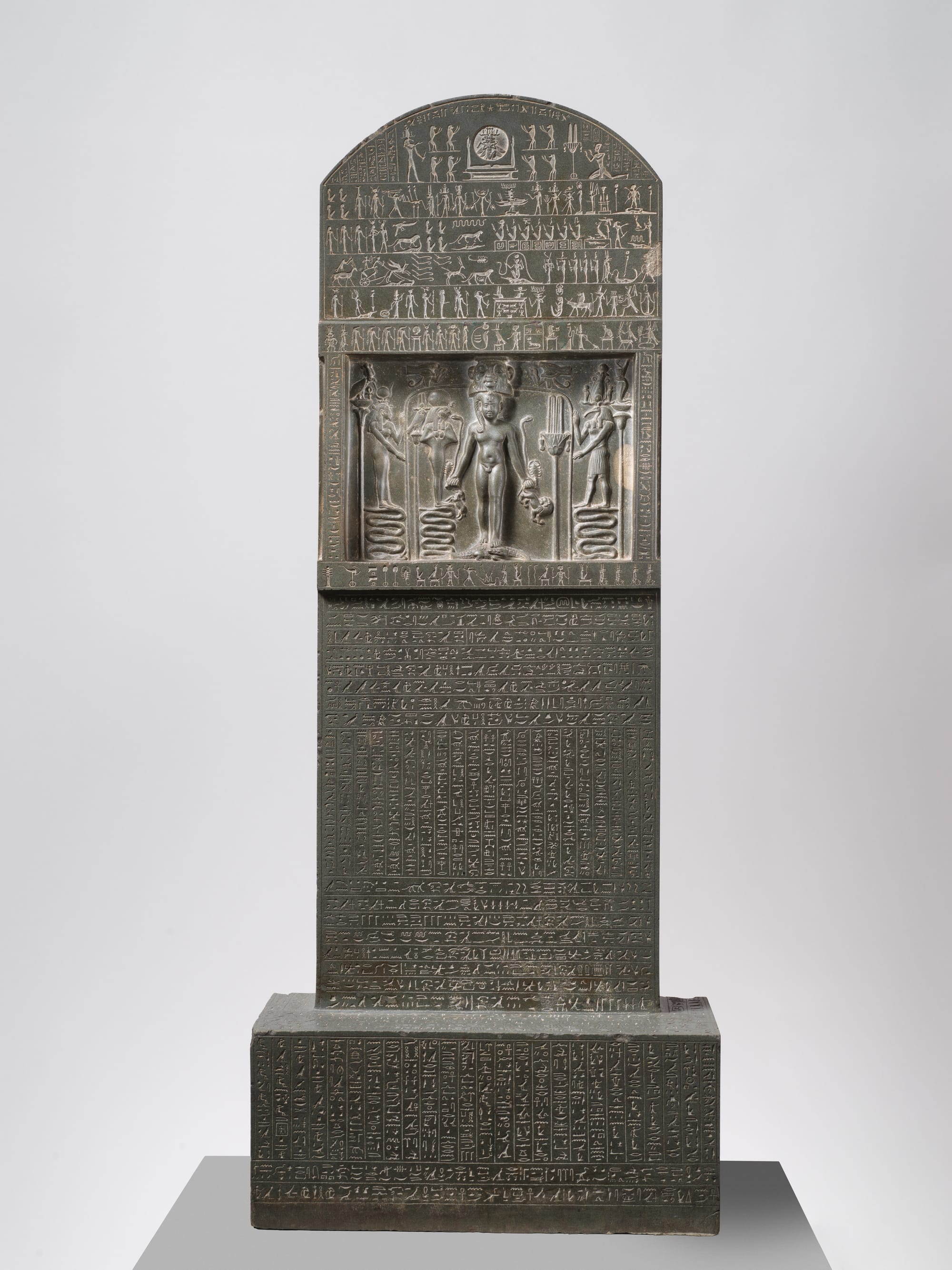
In the fourth century BC, an Egyptian priest commissioned an object that I consider to be one of the most special from all of ancient Egypt. This stone, known as the Metternich Stela, is part religious art, part literature, part ancient healing handbook. And not just healing for humans either.
In fact, one of the longest inscriptions on the stone is a remarkable spell for healing a house cat.
Standing about three feet tall, the Metternich Stela is carved from a type of hard, dark stone the Egyptians used when they really wanted an object to last—which pretty much worked out. It's been almost perfectly preserved after 2,400 years, and you can go see it today at the Metropolitan Museum in New York.
If you do, I recommend spending a minute with it. There's a lot to take in, even besides the central image of the child god Horus triumphing over dangerous creatures. The object also contains strange, tiny little scenes and hieroglyphs covering every available surface. The Metternich Stela includes several mythological narratives and a number of healing spells for humans and felines alike.
There's really nothing else quite like it that has survived from ancient Egypt. The central image of the child Horus—victorious over the dangerous creatures of the Egyptian environment, snakes, scorpions, crocodiles—was a motif that became enormously popular in the final centuries of Pharaonic civilization.
Objects featuring this image are called cippi of Horus, and they came in a range of sizes. The Met Museum has one that measures under two inches, small enough to be worn as an amulet around the neck. The Egyptians believed these stones carried real power. The most common theory about how they were used is that water was poured over them and then consumed, absorbing the spells carved into the surface, becoming a kind of holy water. That's certainly how some of the larger healing statues worked. One of the most famous ones, the statue of Djed-Hor the Savior, even has a stone basin carved at the feet to catch the runoff.
But when one Egyptologist looked closely at the wear patterns on the smaller Horus statues, she noticed something that didn't quite fit.
There are no clear signs of water erosion. Instead, the erosion is concentrated on certain parts, especially the face of Horus. On many of the surviving examples, Horus' face has been rubbed almost completely smooth.
There are also no explicit instructions to pour water over the objects. The statues weren't being doused in water. They were being touched. Which makes the Metternich Stella all the more interesting, because its carvings aren't worn down at all. Its relief is crisp. In all likelihood, this object sat somewhere safe, consulted only on the occasions where it was merited.
One of those occasions, it turns out, may have been an unfortunate encounter between a cat and a scorpion. The stela contains not one, but three different spells for healing an ailing cat. I'm pretty sure that settles the question of how the Egyptians felt about felines.
The longest of the three spells runs more than 600 words. This was not some perfunctory prayer. It begins by calling on the sun god Ra, patron of felines. "O sun, come for your daughter, for a scorpion has bitten her, and her cry reaches above."
Then, speaking in the voice of the sun god himself, the spell addresses the cat directly: "Don't fear, my daughter. Here I am around you. I am the one who fells for you the poison."
But that's just the opening. The main body of the spell uses a technique that was a hallmark of Egyptian ritual, called the "deification of the limbs."
The spell systematically moves through the cat's body, part by part, and identifies each part with a deity. "You cat, your head is the head of Ra. You cat, your nose is the nose of Thoth. You cat, your heart is the heart of Ptah. Your belly is the belly of Osiris. Your feet are the feet of Amun." Get the idea?
The actual spell is far more descriptive than that, though. To the Egyptians, words carried power, and when it came to enchantment, brevity was rarely the goal.
And so it goes on like that, head to toe, until every limb of the cat has been identified with a deity. Then finally, the spellcaster declares, "There is no limb in you free of a god." They were not merely treating a cat. They were reassembling one out of the pantheon.
Of all of the Egyptian texts that I've read, I consider this one of the most moving. There's just a tenderness and a seriousness to it. You can't rule out the possibility that somebody, at some point, knelt down next to a sick cat and recited this very spell.
But this was a futile gesture, right? It's all just superstition, and today we know better? That depends how you look at it. Whatever you believe about the metaphysics, the owner of this cat would have felt that by reciting this spell, they were doing everything they possibly could for the creature, given the treatment options available at the time.
I'm sure many pet owners today can relate to that. I certainly can. And imagine what a powerful experience it would have been to actually speak those words, to feel like you were connecting heaven to earth on behalf of a helpless animal that you loved, and finally to address her with the extraordinary declaration: "There is no limb in you free of a god."
Bibliography
- Allen, James. "The Metternich Stela." In The Art of Medicine in Ancient Egypt (2005), pp. 49-63 Free PDF.
- DuQuesne, Terence. "La déification des parties du corps. Correspondances magiques et identification avec les dieux dans l'Égypte ancienne" in La magie en Egypte, a la recherche d'une definition (2002), pp. 239-271
- Gasse, Annie. Les stèles d'Horus sur les crocodiles (2004)
- Kákosy, László. Egyptian Healing Statues in Three Museums in Italy (Turin, Florence, Naples) (1999)
- Metropolitan Museum of Art. "Magical Stela with Horus the Child," object no. 50.85.
- Nunn, John. Ancient Egyptian Medicine. (1996)
- Patch, Diana Craig, and Hainline, Brendan (editors). Divine Egypt (2025)
- Pinch, Geraldine. Magic in Ancient Egypt (2006)
- Price, Campbell. "On the function of 'healing' statues." In Mummies, Magic and Medicine in Ancient Egypt: Multidisciplinary Essays for Rosalie David (2016), pp. 169–182
- Quack, Joachim. Review of Sternberg-el-Hotabi, Untersuchungen zur Überlieferungsgeschichte der Horusstelen. In Orientalistische Literaturzeitung 97, no. 6 (2002), columns 714–729
- Ritner, Robert. "Horus on the Crocodiles: A Juncture of Religion and Magic in Late Dynastic Egypt." In Religion and Philosophy in Ancient Egypt (1989), pp. 103–116
- Ritner, Robert. The Mechanics of Ancient Egyptian Magical Practice (1993)
- Sanchez, Gonzalo, and Meltzer, Edmund. The Edwin Smith Papyrus: Updated Translation of the Trauma Treatise and Modern Medical Commentaries (2012)
- Sauneron, Serge. Un traité égyptien d'ophiologie: Papyrus du Brooklyn Museum nos. 47.218.48 et .85. (1989)
Images
- Author photos:
- at Met Museum: Metternich Stela, Horus cippi, cat statues, Amun statue
- temple reliefs: Ra (Medinet Habu), Thoth with Seti I (Tomb of Seti I), Ptah (Kom Ombo), Osiris (Hathor temple, Deir el-Medina), Thoth with hieroglyphs (Temple of Seti I, Abydos)
- Metropolitan Museum of Art (object photography): Metternich Stela, Horus cippi, cat statues (including cat statue on thumbnail image)
- Les stèles d'Horus sur les crocodiles (object photography): Horus cippi
- Onceinawhile (shared under Creative Commons): statue of Djed-Hor
- The Trustees of the British Museum: painting of cat with its owner, Tomb of Nebamun, Thebes.
References
"…one of the most special from all of ancient Egypt."
The Metternich Stela, Metropolitan Museum of Art, object no. 50.85; Dynasty 30, reign of Nectanebo II (360–343 BCE); believed to have been originally erected in a temple of the Mnevis bull at Heliopolis, it was commissioned by one of the temple's priests, named Esatum. The object was probably moved to Alexandria in the Ptolemaic Period, where it was found in the early 19th century. (Met catalogue entry here.) As of this writing in mid-2026, the stela is on display at The Met in Gallery 128, in the Late Period rooms of the Egyptian wing. (The museum titles the object "Magical Stela" rather than "Metternich Stela.")
The English translation I am using is from James Allen in The Art of Medicine in Ancient Egypt (2005), pp. 49–63. The volume is available free online via the Met.
"…part ancient healing handbook."
While the Metternich Stela largely concerns the so-called "magical" treatments common in the ancient world, Egypt was also a recognized hub in antiquity for what we'd today call "conventional" medicine. See John Nunn, Ancient Egyptian Medicine (1996). The Edwin Smith Papyrus (circa 1600 BCE) covers 48 case histories of wounds and injuries and is almost entirely free of spell material. See James Henry Breasted, The Edwin Smith Surgical Papyrus (1930), or even better, the updated and corrected 2012 edition from Gonzalo Sanchez and Edmund Meltzer - The Edwin Smith Papyrus: Updated Translation of the Trauma Treatise and Modern Medical Commentaries.
A notable example is Case 8 (2012 edition, pp. 86-94). It describes severe neurological symptoms, but with no open wound; and yet the symptoms are not viewed as the result of malefic forces or treated with a "magical" prescription. This is "extraordinary" for a text of this period, Sanchez writes, since it reveals that the ancient physician had acquired an understanding of intracranial injury of this type "beyond the damaging effect produced by demonic forces" (The Edwin Smith Papyrus, 2012, p. 92).
The Brooklyn Snake Papyrus is also noteworthy as a treatise on snakes and snakebites that features a number of pharmacological treatments. This is the best illustration that even poisoning by venom received "conventional" treatment in ancient Egypt. See Serge Sauneron, Un traité égyptien d'ophiologie: Papyrus du Brooklyn Museum nos. 47.218.48 et .85 (1989).
Nunn perhaps puts it most succinctly when he writes that "most incantations were intended to be used together with a conventional remedy" (Ancient Egyptian Medicine, p. 105). See also Geraldine Pinch, Magic in Ancient Egypt (2006), especially Ch. 10.
"…strange, tiny little scenes and hieroglyphs covering every available surface."
For statues inscribed with similar scenes, see László Kákosy, Egyptian Healing Statues in Three Museums in Italy (1999). (WorldCat link)
"Objects featuring this image are called cippi of Horus…"
For a good summary on the genre see Kákosy, Egyptian Healing Statues, p. 9, and Robert Ritner, "Horus on the Crocodiles: A Juncture of Religion and Magic in Late Dynastic Egypt," in Religion and Philosophy in Ancient Egypt (1989), pp. 103–116.
(Heike Sternberg-el-Hotabi's Untersuchungen zur Überlieferungsgeschichte der Horusstelen (1999) was not consulted—see Joachim Quack's review in Orientalistische Literaturzeitung 97, 2002.)
"…when one Egyptologist looked closely at the wear patterns…"
This is Annie Gasse and her 2004 catalogue of the Louvre's collection - Les stèles d'Horus sur les crocodiles (check WorldCat for libraries that have it). In the section headed "Wear and Use" (pp. 21–22), Gasse observes that setting aside breakage, almost none of the Louvre cippi preserve the face of Horus intact. On most pieces it is specifically the face of the god that is worn smooth. Her key inference is that immersion in water cannot explain this, since soaking would more uniformly erode the object; the concentrated wear instead points to repeated rubbing and contact—the practitioner touching the stone, or bringing it into contact with the patient (the lips, or the site of the wound), most likely alongside recitation of the spells inscribed on it. She notes that some pieces, carved in extremely hard stone, are worn enough to imply use hundreds or thousands of times, which could also help explain why relatively few cippi survive.
The catalogue focuses on the roughly 40 Horus stelae at the Louvre, but Gasse frames her conclusions as applying to the genre more broadly.
Those who have advocated for usage of the objects with water have included Allen, who wrote that "the Egyptians believed that water poured over it could absorb their efficacy and serve as a magical antivenom." (Allen 2005, p. 49). This notion is likewise presented by Ritner in his "Horus on the Crocodiles" article, though he also mentions "kissing or rubbing the stela to impart the curative power directly onto the patient." (p. 108) On the underlying mechanism for transfer of power through "swallowing," see Ritner's The Mechanics of Ancient Egyptian Magical Practice (1993), esp. pp. 105–110, and "Horus on the Crocodiles," pp. 107-108.
"…not one, but three different spells for healing an ailing cat."
The three cat spells are translated in Allen 2005, pp. 53–54. The two other cat spells are much briefer, running about 50 words a piece.
"...called the "deification of the limbs."
The technique of identifying each body part with a deity is a widely recognized Egyptian ritual genre, as mentioned in the video. See for instance, Terence DuQuesne, "La déification des parties du corps. Correspondances magiques et identification avec les dieux dans l'Égypte ancienne" in La magie en Egypte, a la recherche d'une definition (2002), pp. 239-271.
Crucially, DuQuesne does not think this was merely a literary metaphor; rather, by reciting the formula, a real transformation was believed to occur.
"The owner of this cat would have felt that by reciting this spell..."
The psychological benefits of these practices have not been ignored by Egyptologists. See for example, Allen 2005 (p. 51): "Together with the stela's images of these gods and other protective forces, they were a powerful psychological weapon in the armarium of ancient Egyptian medicine."

Comments ()